
...
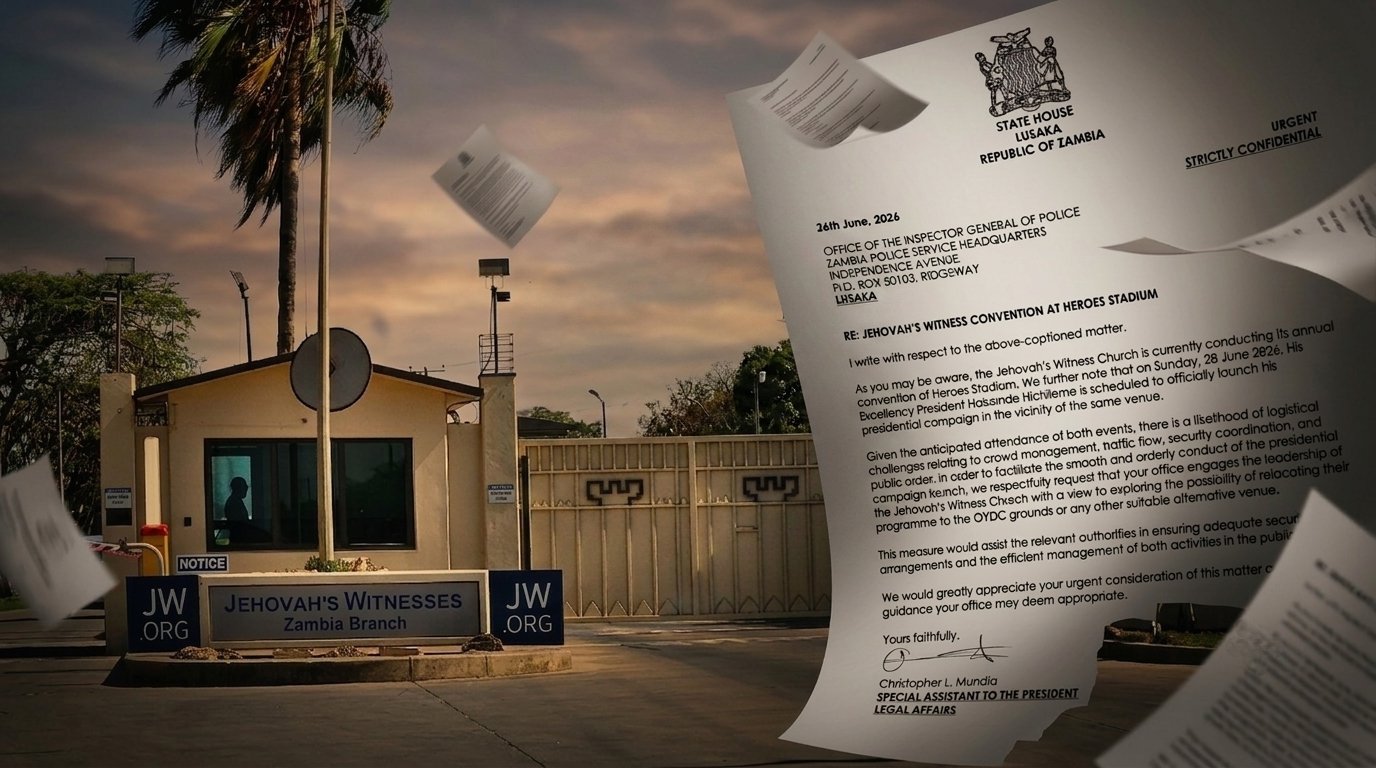
What was initially framed by state actors as a routine logistical rescheduling at the National Heroes Stadium is rapidly escalating into an explosive political and constitutional controversy. Following a sharp public outcry regarding the abrupt displacement of the Jehovah’s Witnesses' annual "Eternal Happiness" Regional Convention to clear the path for a ruling United Party for National Development (UPND) campaign rally, the emergence of an unverified internal State House memo has dramatically shifted the narrative from a mutual compromise to serious allegations of executive coercion.
The Public Spark: The Liswaniso Disruption Claims
The public controversy originally ignited when unverified social media monitoring networks, including digital channels referencing platform updates, has presented allegations that the ruling party had aggressively overridden a pre-existing, legally binding venue contract. Assertions heavily circulated across online communities claiming that Gilbert Liswaniso, the UPND National Youth Chairman, bluntly informed convention planners that because their religious members maintain absolute political neutrality and do not participate in voting, their spatial rights would not be prioritized over a mobilization rally for President Hakainde Hichilema - we're yet to obtain the official communique.
This initial rhetorical flashpoint triggered immediate domestic backlash, presenting severe public relations hurdles regarding the equitable treatment of non-partisan communities. However, the legal and journalistic dimensions of the story grew exponentially more complex when an internal administrative paper trail was allegedly leaked from the Zambian State House desk.
The Paper Trail: A 48-Hour Ultimatum?
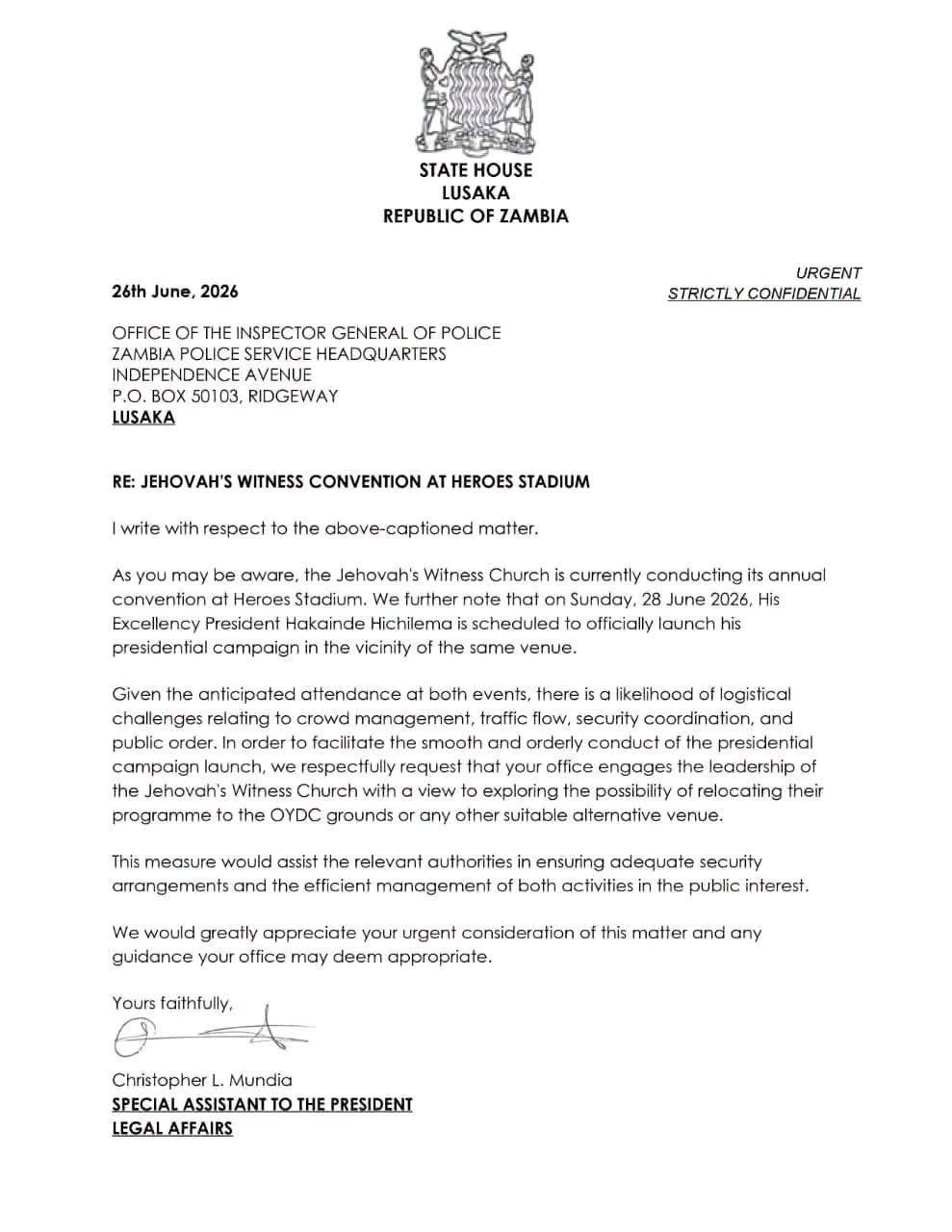
The unfolding dispute now centers squarely on a sensitive correspondence purportedly authored by Christopher L. Mundia, Special Assistant to the President for Legal Affairs. The unauthenticated letter, dated June 26, 2026—just 48 hours prior to the scheduled events—was directed straight to the Office of the Inspector General of the Zambia Police Service. This specific chronological documentation and its associated context were obtained by our news desk through source(s) that's elected to remain completely anonymous to protect their identity.
The documentation has entered the public sphere via the unverified digital file labeled FB_IMG_1782630087051.jpg, which is attached in this article without including the raw image asset explicitly. Marked under "Urgent" and "Strictly Confidential" protocols, the text of the memo highlights projected logistical gridlock, crowd safety hazards, and public order considerations resulting from the overlap between the massive spiritual assembly and the President's campaign launch, calling on the police apparatus to intervene.
If authenticated, this document carries profound legal implication violations . It directly challenges initial claims allegedly made by the Ministry of Youth, Sport and Arts suggesting a wholly organic, administrative accommodation. Instead, it indicates that the structural impetus to vacate the facility originated from the highest executive office in the country, leveraging police mediation under a critically compressed timeline.
‘The Church has been told to find another venue for their programs but they ended up cancelling the physical annual event... Some people travelled from everywhere in Zambia. Yesterday, Gilbert Liswaniso told the Jehovah's Witness that they do not vote, therefore, they will not be excused to stop UPND rally.’ — Source Data: Unverified Social Media Reporting
Human and Logistical Costs: The Impact on Delegates
While the administrative leak proposed an emergency relocation to the nearby OYDC (Olympic Youth Development Centre) grounds, technical planners understand that migrating an assembly of several thousand people cannot structurally occur within a 48-hour window. Left with no viable physical alternative, local convention coordinators were forced to abruptly cancel the physical stadium footprint and pivot entirely to a decentralized, virtual streaming layout.
This emergency operational shift has imposed punishing financial and logistical costs on ordinary families, who would be forced to go back to the Covid-19 era style of assembling. Thousands of delegates had already traveled into the capital city from distant geographic provinces across Zambia, expending unrecoverable funds on multi-day bus transit, localized hospitality lodging, and pre-booked catering services. For individual households and low-income congregation members—many of whom spent months carefully saving to attend this specific event—the loss of the physical venue represents a major financial blow, leaving families stranded or forcing sudden, expensive return trips.
A Broader Concern: The Right to Contract and Fair Assembly
Legal analysts argue that this incident extends far beyond the operational parameters of a single denomination. Verifiable venue allocation timelines indicate that the Jehovah’s Witnesses administration had fully, legally, and transparently secured and settled payments for the National Heroes Stadium months in advance. By allegedly permitting a ruling political campaign to deploy state influence to displace a prior commercial contract, the event risks establishing a volatile precedent for institutional consistency and property laws in Zambia.
Civil society watchdogs note that if an active, paid contract for a public facility can be set aside on short notice to make way for a state political rally, it raises foundational questions regarding the security of assembly and speech rights for all independent civic bodies, corporate organizations, and minority faith groups seeking access to state-managed national infrastructure.
The Irony of Global Neutrality
The targeting of this specific international community highlights a profound sociological irony. Globally, Jehovah’s Witnesses are structurally recognized for their absolute adherence to scriptural non-partisanship. In every sovereign jurisdiction where they exist, they explicitly abstain from participating in political campaigns, running for public office, voting, joining partisan rallies, or entering ideological disputes, maintaining a clean, decades-long global record as strictly peaceful, law-abiding citizens who entirely decouple faith from state politics.
Independent political analysts suggest that this precise vulnerability may have factored into the campaign’s scheduling calculations. Because the organization does not form voting blocs, fund political candidates, or engage in civic retaliation, strategists may have assumed the organization would quietly absorb the logistical and financial shock without creating electoral blowback. However, the subsequent interception and public distribution of the internal letter by secular political opposition channels has ensured that the administration faces heavy, ongoing public accountability regardless.
An Evolving Narrative
As of June 28, 2026, the UPND presidential campaign launch is progressing directly on the turf of the National Heroes Stadium, while thousands of displaced delegates across Lusaka adapt by tuning into their regional spiritual program via remote digital streams. The long-term journalistic positioning of this story depends on formal verification or clear counter-statements regarding the "Mundia Memo" by State House. Until definitive, binding records are established by the police service or direct legal representatives, the incident stands as a powerful, evolving allegation testing the boundaries of civic rights in a high-stakes electoral cycle.
Add new comment