
...
💰 Nigerian Bank Customers Are Getting a Major Fee Relief—Here's What's Free Now
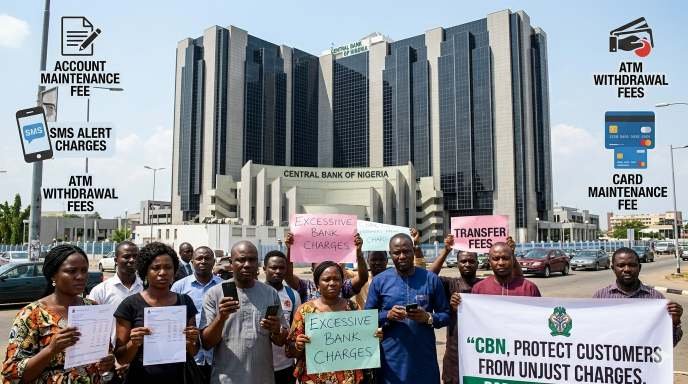
Down the bustling streets of Lagos—where market traders, tech startups, and diaspora families move billions monthly through mobile wallets—one change is already being felt: five everyday banking services are now free, starting May 1, 2026.
This isn't just about saving a few naira. The CBN's revised Guide to Charges by Banks and Other Financial Institutions, 2026 is a strategic move to boost financial inclusion, reduce "nuisance fees," and drive digital payments adoption across Nigeria's 220 million-person economy.
For readers worldwide familiar with hidden bank fees, account maintenance charges, or ATM nightmares, this reform mirrors India's 2016 digital push and the EU's 2015 payment services directive—both aimed at making banking cheaper and more transparent.
🎯 The 5 Banking Services That Are Now Completely Free
The CBN's new rules explicitly prohibit banks from charging for these key services:
- 1. Account reactivation and closure — Dormant accounts can be reactivated at no cost. Closing savings, current, or domiciliary accounts is also free.
- 2. Monthly statement of account — Both digital and printed monthly statements are free. Only extra printed statements outside the standard format cost up to ₦20 per page.
- 3. Virtual cards and PIN management — Virtual card issuance is free. PIN re-issuance, resets, and management services attract zero charges.
- 4. Own-bank ATM withdrawals (On-Us transactions) — Withdraw cash from your bank's own ATMs for free. Intra-bank transfers at these ATMs are also free.
- 5. Small inter-bank electronic transfers — Transfers from ₦0 to ₦5,000 are free for many customers, removing a major barrier for micro-transactions.
📊 New Transfer Fee Caps (Effective May 1, 2026)
Transfer Amount | Maximum Fee | Who Benefits |
|---|---|---|
₦0 – ₦5,000 | Free | ✅ Micro-payments, daily traders, students |
₦5,001 – ₦50,000 | ₦10 max | ✅ Small business owners, remittance receivers |
₦50,001+ | ₦50 cap | ✅ Large transfers, salary payments |
Source: CBN Revised Guide to Charges 2026
🔐 BVN & Account Security Rules Tighten—Here's What Changed
While fees are dropping, security requirements are tightening. Starting May 1, 2026:
- Accounts without BVN or NIN will be frozen — No exceptions. This is to strengthen identity verification and reduce fraud.
- Phone number changes linked to BVN are limited to once in a lifetime — Choose your number carefully.
- Banks must place suspicious BVNs on a 24-hour watchlist — Accounts may be temporarily frozen during verification.
- Minors under 18 can no longer hold independent BVNs — Must be linked to guardians.
This mirrors global trends: the UK's 2020 open banking rules and U.S. CCPA identity verification standards enforce similar "know your customer" protocols to combat financial crime.
💸 Cash Withdrawal Limits & Fees: What You Need to Know
Effective January 1, 2026, the CBN revised cash withdrawal limits to reduce cash management costs for banks while giving customers more flexibility:
📊 Weekly Cash Withdrawal Limits (2026)
Category | New Limit | Old Limit (2022) | Penalty on Excess |
|---|---|---|---|
Individuals | ₦500,000/week | ₦100,000/week | 3% flat (shared: 40% CBN, 60% bank) |
Companies | ₦5M/week | ₦500K/week | 5% flat (shared: 40% CBN, 60% bank) |
ATM Daily | ₦100,000/day | ₦100,000/day | No separate penalty |
Source: CBN Circular December 2, 2025
Key change: Cash deposit limits and fees have been completely removed. You can now deposit any amount for free—a massive boost for cash-intensive businesses.
🏦 Bank Recapitalization: 30 Banks Meet New Capital Requirements
Parallel to the fee reforms, the CBN's ₦4.65 trillion recapitalization exercise concluded in March 2026. 30 banks met the new minimum capital thresholds:
- International authorization: ₦500 billion (up from ₦25 billion)
- National authorization: ₦200 billion (up from ₦15 billion)
- Regional authorization: ₦50 billion (up from ₦5 billion)
72.55% of the capital came from local investors, signaling renewed confidence in Nigeria's financial system.
🌍 Why This Matters Beyond Nigeria
The World Bank upgraded Nigeria's 2026 growth forecast to 4.4% from 3.7%, citing these reforms, alongside tax improvements and investor confidence gains.
The CBN cleared over $7 billion in FX backlog, unified exchange rates, and returned to international capital markets in December 2025—earning praise from multilateral organizations as a "bold intervention."
This is the same roadmap used by Ghana (2019 banking cleanup) and Kenya (2020 M-Pesa fee reforms)—painful short-term adjustments to build long-term resilience.
❓ Your Turn: Which Fee Change Impacts You Most?
Have you already reactivated a dormant account for free? Are you using virtual cards instead of physical ones now? Drop your experience in the comments—your story could help others navigate these changes.
Share this article with someone who still pays for account statements or ATM withdrawals—they need to know this is now free.
🔗 Recommended External Links for Further Reading
- 5 Banking Services Now Free as CBN Announces Withdrawal, Deposit Fees Changes — Complete breakdown of free services
- CBN Reforms and Initiatives - Official Page — Official minimum capital requirements and policy circulars
- What You Must Know As CBN Tightens BVN Rules From May 1 — Complete BVN compliance guide
Add new comment